Data Residency Isn't Data Sovereignty: What Canadian Businesses Should Know About E-Signatures
Storing your signed documents on Canadian servers is not the same as keeping them under Canadian law. If your e-signature provider is US-owned, the US CLOUD Act can compel it to hand over your data even when that data sits in Canada. For genuine data sovereignty, the provider itself has to be Canadian, not just its data centre.
Most Canadian organizations are in one of two places when it comes to signatures. Either they are still moving paper around, printing, signing, scanning, and chasing people for a signature that will hold up, or they have adopted an e-signature tool, put the paperwork behind them, and moved on. If you are in the first group, the case for going digital is obvious. If you are in the second, there is a question worth asking that most organizations never do: where do your signed documents actually live, and whose laws govern them?
In more than fifteen years working with documents and technology, I have found that the honest answer, for a lot of businesses, is that they do not know. And for signed documents, which are some of the most sensitive records an organization holds, that is worth fixing.
Going paperless is only half the decision
Moving from wet-ink to electronic signatures solves a real and familiar problem. Paper-based signing is slow, hard to track, and easy to lose. You print, you route, you wait, you re-scan, and at the end you often cannot prove exactly who signed what and when. An e-signature platform fixes all of that, which is why so many organizations adopt one and never look back.
But choosing an e-signature platform is not only a workflow decision. It is also a decision about where your documents will be hosted and whose laws will govern them. That second decision usually gets no attention at all, and it is the one that can come back to bite you.
Where do your signed documents actually live?
Most of the best-known e-signature platforms, including DocuSign and Adobe Acrobat Sign, are US-owned. Many of them now offer to store Canadian customers' data in Canadian data centres, which sounds like it settles the question of where your documents live. It does not.
Where data physically sits, its residency, is not the same as which country's laws control it, its sovereignty. Those two ideas get treated as interchangeable, and they are not. You can have Canadian data residency and still not have Canadian data sovereignty.
Data residency is not data sovereignty
Here is the mechanism that makes the difference. The Clarifying Lawful Overseas Use of Data (CLOUD) Act, passed in the United States in 2018, lets US law enforcement compel a US-based service provider to produce data in its possession, custody, or control, regardless of where in the world that data is stored. A US-owned provider can be required, under US law, to hand over your documents even if those documents are held on servers in Canada, and even if you are a Canadian organization that never intended anyone outside your walls to see them.
That is why residency, on its own, is not sovereignty. Sovereignty is about control, and control follows ownership and jurisdiction. If the company that runs your e-signature platform answers to US courts, then so, ultimately, can your data.
This is not a fringe interpretation. Canadian law firms have been flagging it for years, and the Government of Canada's own guidance on data sovereignty and the public cloud makes the point plainly: as long as a provider operating in Canada is subject to the laws of a foreign country, "Canada will not have full sovereignty over its data." A Canadian data centre operated by a foreign-owned company does not close that gap. Only Canadian ownership does.
Why this matters most for signed documents
Signed records are not just any data. They are contracts, consents, HR files, financial authorizations, and health forms, the documents that carry your organization's commitments and your clients' personal information. Signing is also the moment those documents leave your hands and land in a platform's custody.
For regulated organizations, the stakes are higher still. Healthcare providers under PHIPA, financial institutions, and public-sector bodies all have obligations about how personal information is handled and who can access it. Exposure to foreign legal access is not just uncomfortable in those settings; it can be a compliance problem. When the first question in a procurement review is "where does the data live, and who can reach it," a foreign-owned platform with a Canadian data centre is a hard answer to defend.
What to look for in a sovereign e-signature provider
If data sovereignty matters to your organization, and for most Canadian organizations handling personal information it should, these are the things that actually determine it:
- Canadian ownership, with no foreign parent. This is the deciding factor. A provider that is not owned by or subsidiary to a foreign company cannot be compelled to disclose your data under a foreign law like the CLOUD Act.
- Built and hosted in Canada, not just a residency option. The data, the infrastructure, and the people who run it should all be in Canada.
- A clear security posture. Look for real, verifiable controls such as Protected B facilities, SOC 2 Type II auditing, and ITSG-33 alignment.
- Legally binding under Canadian law. Electronic signatures are enforceable in Canada under PIPEDA and provincial electronic-commerce legislation when identity, intent, and document integrity are preserved.
Residency is table stakes. Ownership is what makes a provider sovereign.
A genuinely Canadian option: NimbleSign
This is the gap Nimble built NimbleSign to close. NimbleSign is a full e-signature platform, remote signing plus in-person signing, that is 100% Canadian-owned with no foreign parent and built and hosted in Canada on Nimble's own Protected B facilities. Your documents and signatures never leave Canadian jurisdiction and are not exposed to the CLOUD Act. The infrastructure is SOC 2 Type II audited and ITSG-33 aligned, and signatures are legally binding under PIPEDA and provincial legislation.
The same reasoning applies across the rest of Nimble's document services, but e-signature is where it shows up most immediately, because signing is the point where your most sensitive documents change hands. In my experience, once an organization realizes that choosing a signing platform is also choosing a jurisdiction, the conversation changes quickly.
Nimble has been trusted with Canadian organizations' documents since 2003. NimbleSign brings that same Canadian footing to electronic signatures.
Frequently asked questions
What is the CLOUD Act? The Clarifying Lawful Overseas Use of Data (CLOUD) Act is a US law passed in 2018 that lets US law enforcement compel US-based service providers to produce data in their possession, custody, or control, no matter where in the world the data is stored, including in Canada.
Does storing my data in Canada protect it from foreign access? Not by itself. If your provider is US-owned, it can still be required under US law to hand over your data even when that data is stored in a Canadian data centre. Data residency is not the same as data sovereignty; ownership and jurisdiction are what decide it.
Are electronic signatures legally binding in Canada? Yes. Electronic signatures are legally binding in Canada under PIPEDA and provincial electronic-commerce legislation, such as Ontario's Electronic Commerce Act and British Columbia's Electronic Transactions Act, as long as the signer's identity and intent are clear and the document's integrity is preserved.
How do I know if an e-signature provider is truly Canadian and sovereign? Look past data residency to ownership. Ask whether the company is Canadian-owned with no foreign parent, whether the platform is built and hosted in Canada, and what security certifications it holds. A Canadian data centre run by a foreign-owned company does not give you sovereignty.
Is NimbleSign a fully Canadian e-signature solution? Yes. NimbleSign is 100% Canadian-owned, built and hosted in Canada on Protected B facilities, and outside the reach of the CLOUD Act, with signatures that are legally binding under Canadian law.
Keep your signatures on Canadian soil
Going digital with signatures is the easy call. The harder, and more important, call is making sure your signed documents stay under Canadian law once you do. If you want to see what a fully Canadian, sovereign e-signature platform looks like, start a free 7-day trial of NimbleSign and send your first forms today, no call required. For a larger organization, or to see it on one of your own forms first, request a demo.
More from the blog
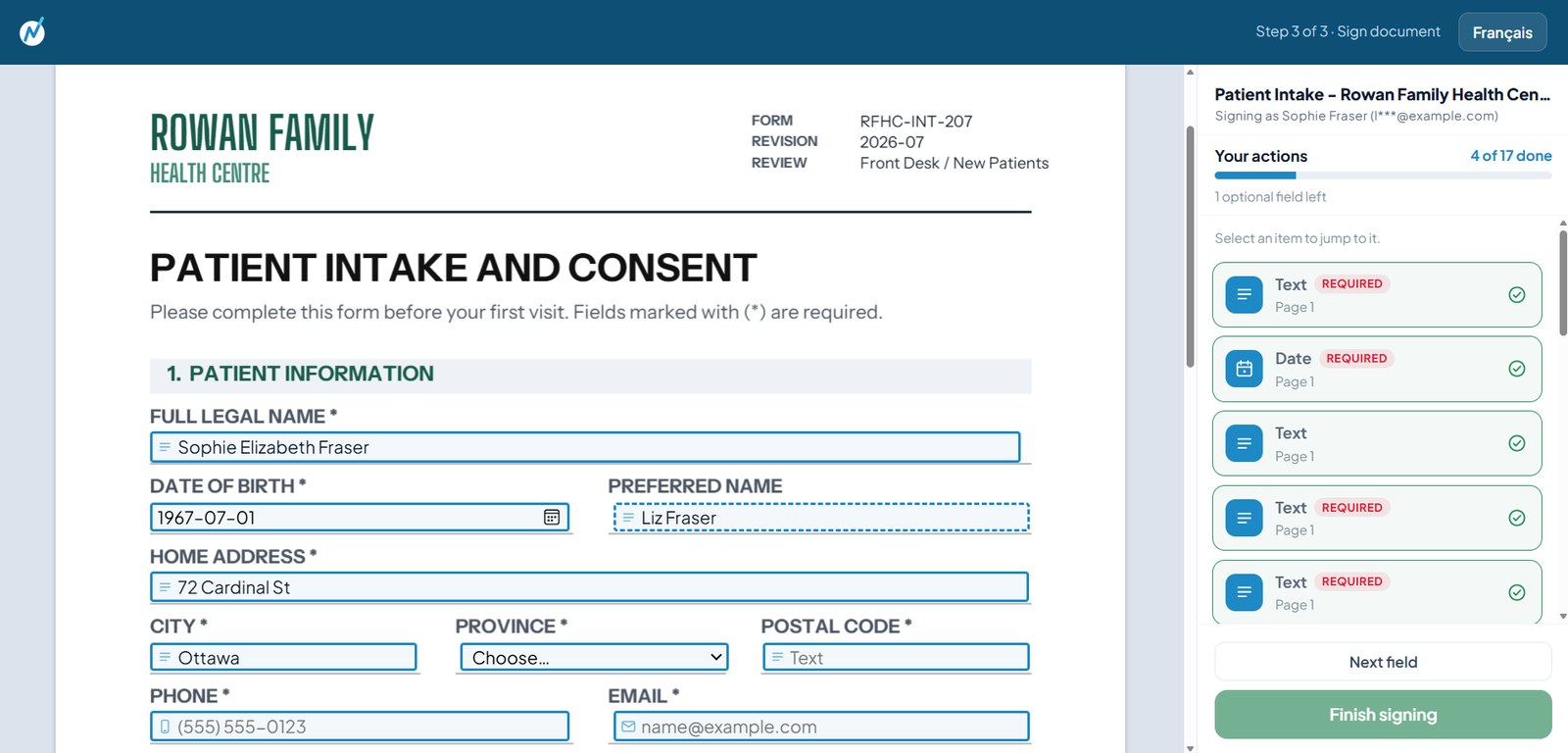
Introducing NimbleSign: A Fully Canadian E-Signature Platform, Built and Hosted in Canada
NimbleSign is here: a fully Canadian electronic signature platform, built and hosted in Canada by Nimble. It handles everyday remote signing from any device and turns tablets into in-person signing stations for places like clinic front desks. Every signature stays in Canada, under Canadian law, with a full record.

How the Kingston ODSP Office Recovered 7,500 Files After a Fire
After a December 2016 fire compromised roughly 12,000 client files at the Kingston ODSP office, Nimble cleaned the records and digitized and indexed 7,500 active files within a three-month window. About 4 million pages of client files are now securely accessible online through a Canadian-hosted portal.

Document Scanning In-House vs. Outsourcing: How Canadian Organizations Decide
Choosing between in-house and outsourced document scanning comes down to five factors: volume, record sensitivity, compliance and data sovereignty, in-house capacity, and risk. In-house suits small, ongoing, low-sensitivity scanning; outsourcing suits large backfile conversions, sensitive records, and firm deadlines. Here is how Canadian organizations weigh the trade-offs before starting a project.