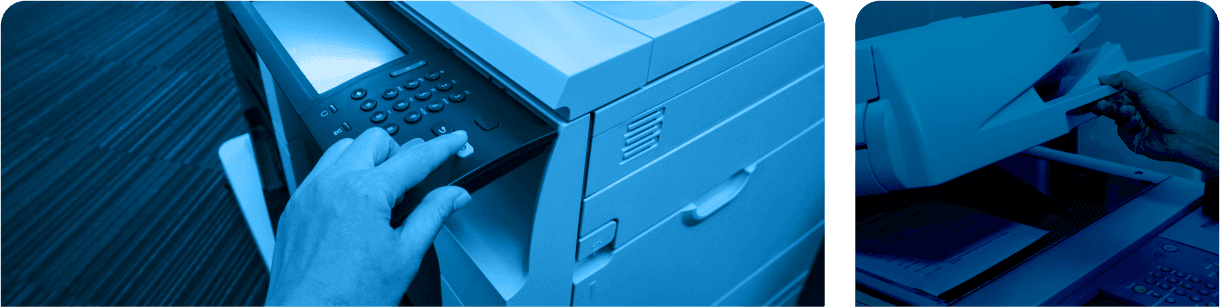
Document Scanning & Conversion Services in Canada
From banker's boxes to microfilm reels — your history, made searchable.
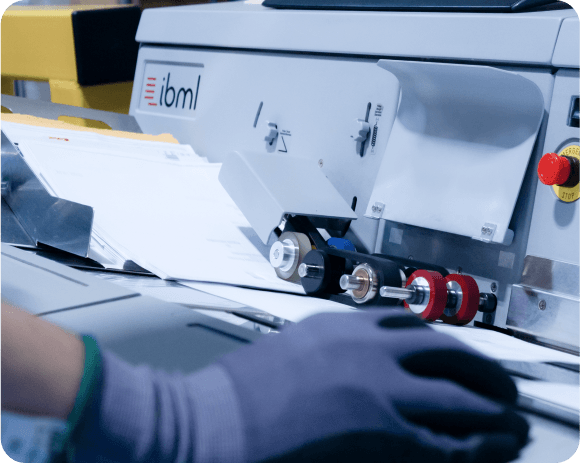
High-volume digitization that turns legacy physical records — paper, microfilm, microfiche, aperture cards, large-format drawings — into high-quality, OCR-enabled, fully searchable digital files. All in Canada.
Scanning and conversion is the high-volume digitization service that turns legacy physical records — paper, microfilm, microfiche, aperture cards, large-format drawings, and other archival formats — into high-quality, OCR-enabled, fully searchable digital files. It's how organizations clear decades of accumulated archives, recover information trapped on aging media, and build a digital record that meets compliance, retention, and discovery requirements.
Nimble operates Canada's largest privately owned scanning fleet across three Protected B cleared facilities, with capacity exceeding one million pages per shift and over 100 dedicated data validation and indexing workstations. We digitize paper documents, large-format and wide-format engineering drawings, 16mm and 35mm microfilm, microfiche, and aperture cards — all to government quality standards, with OCR applied for full-text search, bonded transport, unbroken chain of custody, and your choice of disposition for the originals.
Every image, every keystroke, every record stays in Canada.
Why Organizations Convert Their Legacy Records
Most large organizations are sitting on archives that pre-date their digital systems — patient charts, case files, contracts, drawings, microfilm rolls, and microfiche jackets accumulated across decades. The information is valuable. The media is increasingly fragile. And in many cases, the people who knew how to retrieve from these archives have retired.
Microfilm and microfiche have finite usable lifespans. Acetate-based stock is subject to vinegar syndrome — a chemical degradation that destroys readability and can damage adjacent reels in storage. Aperture cards depend on equipment that's no longer manufactured. Paper records consume real estate at scale, can't be searched, and create a compliance gap every time a record is needed and can't be found in time. Industry research consistently shows organizations digitizing legacy archives recover staff hours previously spent on retrieval, eliminate physical storage costs, and dramatically reduce compliance risk on records subject to retention or discovery.
Conversion is also a prerequisite for any meaningful AI or analytics initiative on historical data. You can't apply machine learning to a microfilm reel.
Key Benefits
Canada's largest privately owned scanning fleet — Capacity exceeding 1 million pages per shift across three Protected B facilities.
Over 100 data validation and indexing workstations — Dedicated capacity for high-quality indexing, classification, and metadata work.
Every legacy media format handled — Paper, large-format and wide-format drawings, 16mm and 35mm microfilm, microfiche, aperture cards, intelligent data capture.
OCR and full-text indexing on every page — Output is searchable from day one.
Government-grade quality control — Automated and manual QC on every image. Legal certification available.
Bonded transport with chain of custody — Documented from pickup to delivery, audit-ready.
Indexed by Nimble's data intelligence — Documents classified and metadata extracted as they're processed, ready for search and integration.
Disposition your choice — Originals returned, stored in secure archive, or destroyed with certificate of destruction.
All work performed in Canada — Three Protected B facilities. Data never leaves Canadian jurisdiction.
How It Works
A 4-step flow from intake to delivery.
Collection Assessment & Scoping
We inventory your materials — paper, microfilm, large-format, aperture cards, fiche — and assess volume, condition, format, and indexing requirements. You receive a fixed-price proposal with timelines.
Secure Pickup & Transport
Bonded couriers pick up your collection with full chain-of-custody documentation from your facility to our Protected B site. Every transfer logged and certified.
Production Scanning & Quality Control
Documents are scanned at high speed by trained operators. Every image is verified through automated and manual quality control to government standards. All work performed in Canadian facilities.
Indexing, Delivery & Disposition
OCR is applied, full-text indexing completed, metadata extracted, and files delivered to your systems or the Nimble portal. Originals returned, stored in secure archive, or destroyed with certification — your choice.
Collection Assessment & Scoping
We inventory your materials — paper, microfilm, large-format, aperture cards, fiche — and assess volume, condition, format, and indexing requirements. You receive a fixed-price proposal with timelines.
Secure Pickup & Transport
Bonded couriers pick up your collection with full chain-of-custody documentation from your facility to our Protected B site. Every transfer logged and certified.
Production Scanning & Quality Control
Documents are scanned at high speed by trained operators. Every image is verified through automated and manual quality control to government standards. All work performed in Canadian facilities.
Indexing, Delivery & Disposition
OCR is applied, full-text indexing completed, metadata extracted, and files delivered to your systems or the Nimble portal. Originals returned, stored in secure archive, or destroyed with certification — your choice.
Common Use Cases
Scanning and conversion is used wherever organizations need to recover information trapped in legacy formats:
Government and public sector — citizen records, regulatory archives, FOI back-files, land and property records, municipal records, court files
Healthcare — patient charts, clinical records, microfilmed historical records, lab archives
Legal — case files, matter archives, historical client records
Engineering, architecture, and construction — blueprints, technical drawings, project archives, as-built documentation
Energy and utilities — well files, environmental records, regulatory submissions, infrastructure documentation
Insurance — claim history, policy archives, microfilmed broker submissions
Education and research — student records, transcripts, library and archival collections
Corporate records — HR archives, finance back-files, board records, contract archives
Museums, libraries, and historical archives — preservation digitization of fragile or aging collections
How This Differs From...
In-house scanning
Office-grade scanners, ad-hoc operators, and untrained QC produce inconsistent images, slow throughput, and inadequate audit trails. Production scanning at Nimble's scale uses purpose-built equipment, trained operators, automated QC, and dedicated indexing — typically delivering higher quality at lower per-page cost than internal operations, with chain of custody and security certifications most organizations can't replicate.
Active File Management
Active File Management is for ongoing working files — pickup, secure storage, scan-on-demand or scheduled batches over time. Scanning and Conversion Services is for one-time bulk digitization of legacy archives — projects measured in millions of pages or thousands of microfilm reels, with a defined scope and end date. Many organizations use both: Conversion to clear the back-file, Active File Management to handle the forward-going.
Offshore scanning
Cheaper per page, but data leaves Canadian jurisdiction, audit trails are weaker, quality varies with operator skill, and turnaround is constrained by transport. For records covered by Canadian residency requirements (Protected B, PHIPA, PIPEDA), offshore is not an option. All Nimble work is performed in Canada.
Generic document scanning
Many providers handle paper, but few handle the full range of legacy media — 16mm and 35mm microfilm, microfiche jackets, aperture cards, large-format engineering drawings — and fewer still maintain Protected B facilities and bonded transport. Conversion projects often involve mixed media, and a single provider with capability across all formats avoids the project management burden of multiple vendors.
Compliance & Security
Your data is protected with enterprise-grade security and regulatory compliance.
Frequently Asked Questions
What is a scanning and conversion service?
What types of media can Nimble digitize?
What is microfilm conversion?
Why convert microfilm now?
How long does bulk scanning take?
Is the scanning work done in Canada?
What scanning quality standards do you use?
What happens to the original documents after scanning?
How are scanned documents indexed?
Are digitized records legally admissible?
How is chain of custody maintained?
Can Nimble handle fragile or damaged materials?
What's the cost of bulk scanning?
Ready to make your archives searchable?
Book a 20-minute call with our solutions team to walk through your collection — paper, microfilm, microfiche, aperture cards, large-format — and get a fixed-price plan to digitize it in Canada.
Book a Discovery CallWhere This Work Happens
Delivered from three Protected B facilities across Canada
Document Scanning & Conversion Services in Canadais performed inside Nimble’s Protected B cleared scanning centres — with bonded pickup nationwide. Choose the centre nearest you, or let us route through the best fit for your project.
Related Solutions
Microfilm Conversion Services in Canada
16mm and 35mm microfilm rolls converted to high-quality, OCR-enabled, fully searchable digital files. Vinegar-syndrome handling. All in Canada.
Learn MoreAperture Card Scanning Services in Canada
Digitize Hollerith-format aperture cards with embedded 35mm microfilm chips. Capture the drawing, extract the punch and printed metadata, deliver searchable digital records — all in Canada.
Learn MoreEngineering Drawing Digitization in Canada
High-resolution scanning of large-format and wide-format technical drawings — blueprints, schematics, as-builts, architectural plans — indexed by drawing number, revision, project. CAD-ready output. All in Canada.
Learn More