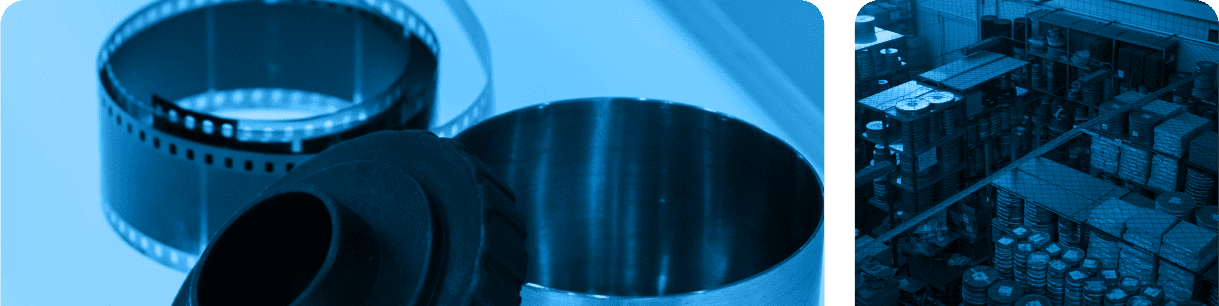
Microfilm Conversion Services in Canada
Recover the records before the film does.
16mm and 35mm microfilm rolls converted to high-quality, OCR-enabled, fully searchable digital files. Vinegar-syndrome handling. All in Canada.
Microfilm conversion is the process of digitizing 16mm and 35mm microfilm rolls into high-quality, OCR-enabled, fully searchable digital files. It's how organizations recover information trapped on aging acetate or polyester film stock, retire microfilm readers that are increasingly difficult to source and maintain, and bring decades of historical records into systems that can actually search them.
Nimble's microfilm conversion runs in our Protected B cleared Canadian facilities, on production-grade microfilm scanners operated by trained technicians. Every frame is captured, image-processed, OCR'd where source quality permits, and indexed to your specifications. Originals are returned, stored in secure archive, or destroyed with certificate of destruction — your choice.
All work happens in Canada. No film, no images, and no data leaves Canadian jurisdiction.
Why Convert Microfilm Now
Microfilm has a finite usable life. Acetate-based stock — the dominant film type used through much of the 20th century — is subject to vinegar syndrome, a chemical degradation that releases acetic acid, distorts the film base, and progressively destroys readability. Vinegar syndrome is autocatalytic: once it starts on a reel, it accelerates, and it can spread to adjacent reels stored in the same vault. The Image Permanence Institute and Library and Archives Canada both document the issue extensively.
Polyester (Estar) film is more stable, but the equipment to read both formats is increasingly difficult to source. Production-grade microfilm scanners are no longer made by most original manufacturers, replacement parts are scarce, and trained operators are aging out of the workforce. Many organizations discover they have decades of records on microfilm but no working reader and no in-house expertise — exactly when a regulatory request, audit, or legal hold demands the records be produced.
Conversion solves both problems at once: it preserves the information before the media degrades further, and it eliminates the dependency on increasingly rare equipment and skills.
Key Benefits
All microfilm formats — 16mm and 35mm rolls, simplex and duplex, rotary and planetary capture, silver halide and diazo film stocks.
Frame-by-frame quality control — Automated and manual QC on every captured image.
OCR and full-text indexing — Output is searchable to the limits of source readability.
Indexed to your specifications — By document type, date range, identifier, or any other metadata your records require.
Vinegar syndrome and degraded film handled — Pre-conversion stabilization and specialty handling for film already showing signs of degradation.
Protected B Canadian facilities — All capture, processing, and storage in Canada.
Bonded transport and chain of custody — Documented from your facility to ours.
Disposition your choice — Originals returned, stored, or destroyed with certification.
How It Works
A 4-step flow from intake to delivery.
Collection Assessment
We inventory your microfilm — number of reels, format (16mm or 35mm), film type (acetate or polyester), condition, indexing needs. You receive a fixed-price proposal.
Bonded Pickup & Transport
Reels are packed and transported under bonded courier to our Protected B facility with full chain-of-custody documentation.
Production Capture
Each reel is scanned on production-grade microfilm equipment, frame by frame, with automated and manual quality control.
OCR, Indexing & Delivery
OCR is applied across all output. Documents are indexed to your specifications, delivered to your systems or the Nimble portal, and originals are dispositioned per your instructions.
Collection Assessment
We inventory your microfilm — number of reels, format (16mm or 35mm), film type (acetate or polyester), condition, indexing needs. You receive a fixed-price proposal.
Bonded Pickup & Transport
Reels are packed and transported under bonded courier to our Protected B facility with full chain-of-custody documentation.
Production Capture
Each reel is scanned on production-grade microfilm equipment, frame by frame, with automated and manual quality control.
OCR, Indexing & Delivery
OCR is applied across all output. Documents are indexed to your specifications, delivered to your systems or the Nimble portal, and originals are dispositioned per your instructions.
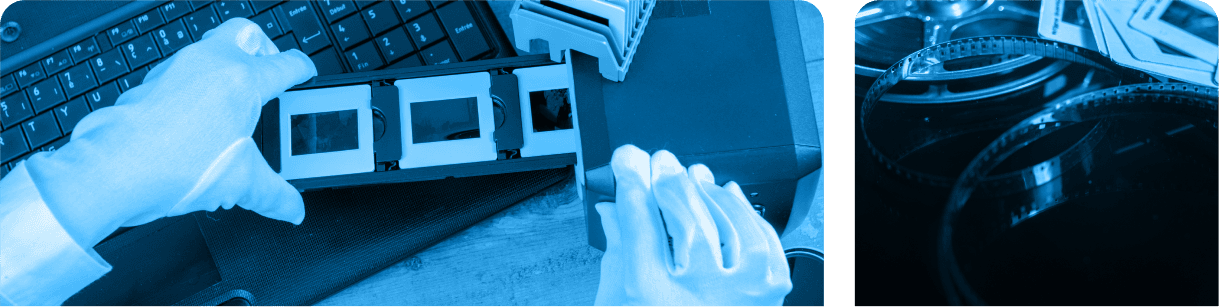
Common Use Cases
Microfilm conversion is used wherever organizations have legacy records on film:
Healthcare — historical patient charts, lab and imaging archives, payer records
Government — citizen records, land titles, court files, regulatory archives, FOI back-files
Financial services — historical account records, transaction archives, signature cards
Insurance — policy archives, claim history, broker submissions
Legal — case file archives, historical client records
Education — student records, transcripts, alumni files
Newspapers and libraries — archival collections, historical periodicals
Corporate records — HR archives, board records, regulatory filings
How This Differs From...
Reading microfilm in-house
Reading microfilm one frame at a time on an aging reader doesn't scale, isn't searchable, and depends on equipment that's increasingly hard to maintain. Conversion captures the entire collection once, makes it searchable forever, and removes the equipment dependency.
Generic document scanning
Most document scanning vendors don't handle film — they handle paper. Microfilm requires specialized capture equipment, specialized handling for fragile or degraded reels, and specialized indexing logic. Nimble's three Protected B facilities include dedicated microfilm capture capacity.
Leaving microfilm in storage
Storage doesn't stop degradation. Acetate film continues to decay even in climate-controlled vaults — slower, but on a measurable timeline. Conversion is the only durable preservation strategy for the information.
Compliance & Security
Your data is protected with enterprise-grade security and regulatory compliance.
Frequently Asked Questions
What is microfilm conversion?
What is vinegar syndrome?
Can you convert film that's already degraded?
What's the difference between 16mm and 35mm microfilm?
What about microfiche or aperture cards?
Can microfilm be OCR'd?
Are converted records legally admissible?
Where is microfilm conversion done?
What happens to my original microfilm reels?
How long does microfilm conversion take?
What does microfilm conversion cost?
Ready to recover your microfilm archive?
Book a 20-minute call with our solutions team to walk through your reels — format, condition, volume — and get a fixed-price plan to convert them in Canada.
Book a Discovery CallWhere This Work Happens
Delivered from three Protected B facilities across Canada
Microfilm Conversion Services in Canada is performed inside Nimble’s Protected B cleared scanning centres — with bonded pickup nationwide. Choose the centre nearest you, or let us route through the best fit for your project.
Related Solutions
Document Scanning & Conversion Services in Canada
High-volume digitization that turns legacy physical records — paper, microfilm, microfiche, aperture cards, large-format drawings — into high-quality, OCR-enabled, fully searchable digital files. All in Canada.
Learn MoreAperture Card Scanning Services in Canada
Digitize Hollerith-format aperture cards with embedded 35mm microfilm chips. Capture the drawing, extract the punch and printed metadata, deliver searchable digital records — all in Canada.
Learn MoreActive File Management in Canada
Take physical files off your premises, store them securely in Canada, and digitize them on a schedule that fits your operations and budget — scan-on-demand, scheduled batches, or full migration over time.
Learn More