Document Scanning In-House vs. Outsourcing: How Canadian Organizations Decide

Whether to scan documents in-house or outsource the project comes down to five factors: the volume you need converted, how sensitive the records are, your compliance and data-sovereignty obligations, the capacity your team actually has, and how much risk you can carry. In-house tends to win for small, ongoing, low-sensitivity scanning. Outsourcing tends to win for large backfile conversions, sensitive records, and firm deadlines.
If your organization still keeps its history in filing cabinets and bankers boxes, you already know the downsides. The paper takes up floor space you pay for, the right document is never easy to find when someone needs it, and a single fire, flood, or burst pipe can erase records you are legally required to keep. What has changed recently is the upside of fixing it: once records are digitized and indexed, modern AI tools can search, classify, and mine them for information that was effectively locked away when it sat on paper.
So the question moves from "should we digitize?" to "how should we do it: build the capability in-house, or hand the project to a service provider?" This article lays out the trade-offs the way we walk clients through them, so you can make the call that fits your organization.
In-house vs. outsourced scanning: the short answer
There is no universal right answer, only the right answer for your volume, your records, and your constraints. Broadly, in-house scanning gives you day-to-day control and works well once a backlog is cleared and you only have a steady trickle of new paper. Outsourcing gives you trained staff, high-speed equipment, and documented security for large one-time conversions and sensitive material. Most organizations end up using both: a vendor clears the historical backfile, and a small in-house setup handles day-forward scanning.
The decision factors, side by side
Here is how the two approaches compare on the factors that actually drive the decision.
Control and convenience
- In-house: You keep documents on site and control the schedule, the order of work, and what does and does not get scanned. Useful when records are needed daily during the project.
- Outsourced: Boxes leave your site under a chain of custody. You give up some hands-on control in exchange for a managed process and a predictable delivery.
Upfront investment and equipment
- In-house: You buy or lease production scanners, capture software, and storage, and you maintain them. Desktop scanners cannot sustain a large backfile; true production hardware is a real capital cost.
- Outsourced: No capital outlay. The provider already owns and maintains the equipment, and the cost is scoped to the project.
Staffing
- In-house: Someone has to do the work. A real project needs document prep (removing staples, clips, and bindings, and inserting separators), scanner operation, indexing and metadata entry, and quality assurance. That is often several roles, pulled from people who already have day jobs.
- Outsourced: The provider supplies dedicated, trained operators for each of those roles, so your team is not pulled off its core work.
Throughput and capacity
- In-house: Throughput is limited by your hardware and how many hours your staff can give it. A large backlog can take many months on an office scanner.
- Outsourced: A dedicated service bureau runs high-speed fleets. Nimble's operation, for example, can process up to one million pages per day, which turns a project that would take an internal team a year into weeks.
Quality and consistency
- In-house: Image quality and index accuracy depend on training and discipline. Inconsistent scans or bad indexing make records hard to find later, which defeats the purpose.
- Outsourced: Established providers run defined quality-control steps and image standards, with QA operators checking batches before delivery.
Security and data sovereignty
- In-house: Records never leave your building, which some organizations require. The flip side is that your building's security, access controls, and backups are only as good as you have made them.
- Outsourced: A reputable Canadian provider offers controlled facilities, security-cleared staff, and a documented chain of custody, and keeps your data inside Canadian jurisdiction. This matters for government, healthcare, finance, and any records touching Canadians' personal information.
Compliance and evidentiary value
- In-house: You are responsible for ensuring scans meet retention rules and stand up as reliable records. This is achievable, but it takes documented process.
- Outsourced: A provider that works to recognized standards can help ensure digitized records remain trustworthy, including for legal admissibility.
Risk
- In-house: Paper stays concentrated in one place during the project, still exposed to fire, water, and loss, and rework falls on you if quality slips.
- Outsourced: Digitizing quickly removes the single-point-of-failure risk of paper, and a good contract puts accountability for quality and security on the provider.
Scalability and timeline
- In-house: Hard to flex. A sudden large volume or a tight deadline can overwhelm an internal setup.
- Outsourced: Built to scale up and down, and to hit fixed deadlines.
When in-house scanning makes sense
In-house is a good fit when your scanning is small, steady, and low-risk. If you have already cleared your historical backlog and only need to capture a modest flow of new documents each week, a production desktop scanner and a trained staff member can be the simplest, most convenient option. It also suits organizations that, for policy reasons, cannot let certain records leave the premises at all, and that are willing to invest in the equipment, training, and quality process to do it properly.
The trap to avoid is underestimating a large backfile. Converting decades of files "when staff have time" often means it never truly gets finished, and half-digitized records are their own headache.
When outsourcing makes sense
Outsourcing is usually the better call for a large one-time backfile conversion, for sensitive or regulated records, for legacy formats, and for any project with a real deadline. You get access to conversion best practices, economies of scale, and dedicated resources without hiring for them. The historical paper is turned into searchable digital records in a fraction of the time, under a documented chain of custody, and your own staff stay focused on their actual jobs.
Legacy media deserves a specific mention. Microfilm, microfiche, aperture cards, and other older formats need specialized equipment and expertise that almost no organization keeps in-house. These are nearly always more sensible to outsource.
The hidden costs of doing it in-house
The reason in-house scanning looks cheaper than it is: most of the cost is not the scanner. It is the labour and the space. A serious backfile project needs prep, scanning, indexing, and QA, and those hours usually come out of employees who already have full workloads. Add the capital cost of production hardware and capture software, the ongoing maintenance, and the floor space the paper occupies while you work through it. Commercial office space in Canada commonly runs upward of $30 to $40 per square foot per year, so the cabinets and boxes holding rarely-touched files are quietly expensive long before you count staff time. None of this is a reason to avoid in-house scanning. It is a reason to price it honestly against an outsourced quote.
Keeping records Canadian, compliant, and admissible
For Canadian organizations, security and data sovereignty are not extras, they are often the whole point. Government departments, hospitals, insurers, and financial institutions handle records that must stay within Canadian jurisdiction and, in many cases, be handled by security-cleared staff in controlled facilities. That is far easier to guarantee with an in-Canada provider than with an ad-hoc internal setup or an offshore option.
There is also the question of whether your digital records will hold up as evidence. Canada's national standard, CAN/CGSB-72.34, "Electronic records as documentary evidence," sets out the practices that keep electronic records trustworthy and admissible in legal proceedings. Whether you scan in-house or outsource, aligning your process with that standard protects you later. We covered this in depth in our article on electronic records as documentary evidence in Canada.
The AI payoff for getting digitized
Digitizing is no longer just about saving space and finding files faster. Once records are captured and indexed, AI and search tools can read across them, extract data, surface patterns, and answer questions in seconds, using information that was completely inaccessible while it sat in a box. Organizations that convert their archives are not just tidying up, they are unlocking a dataset they have owned for years but could never use. That upside applies no matter how you scan, which is one more reason not to let a backlog sit.
Why Nimble can advise either way
Most companies in this space sell you one answer, because they only offer one thing. Nimble sits on both sides. We are an equipment provider, selling, servicing, and maintaining production scanners for organizations that want to build in-house capability, and we are a full-service conversion bureau with a high-speed fleet that can process up to one million pages per day for organizations that would rather outsource. We are also Canadian-owned, with security-cleared staff and facilities across the country, so records stay in Canada.
That dual perspective is deliberate. It means when you ask us whether to scan in-house or outsource, the honest answer is not automatically "hire us." Over decades we have helped hundreds of organizations with projects ranging from a few filing cabinets to conversions of more than 200 million pages, and the right structure genuinely depends on your situation. Sometimes that means we set your team up with the right hardware and a project plan. Sometimes it means we run the whole conversion for you. Often it is a mix.
Frequently asked questions
Should we scan documents in-house or outsource? Scan in-house when the volume is small and ongoing, the records are low-sensitivity, and you have staff and equipment to do it consistently. Outsource when you have a large backfile, sensitive or regulated records, legacy formats, or a firm deadline. Many organizations outsource the historical backlog and keep a small in-house setup for day-forward scanning.
Is it cheaper to scan documents in-house? Not as often as it looks. The scanner is the small part. The real costs are staff time for prep, scanning, indexing, and quality control, plus production hardware, software, maintenance, and the office space the paper occupies. When those are counted honestly, a scoped outsourced project is frequently the lower total cost for a large conversion, and always the faster one.
How long does a backfile scanning project take? It depends on volume and condition, but the gap between approaches is large. An internal team on an office scanner may take many months to clear a big backlog, while a dedicated bureau running high-speed equipment can process the same volume in weeks. Capacity is the difference: a large fleet can handle up to a million pages a day.
Is outsourcing document scanning secure, and does the data stay in Canada? With the right provider, yes. Look for a Canadian-owned company with controlled facilities, security-cleared staff, a documented chain of custody, and a guarantee that your data never leaves Canadian jurisdiction. That is often more secure than an informal in-house process.
What about microfiche, microfilm, and other legacy media? Legacy formats need specialized equipment and expertise that few organizations keep in-house, so they are almost always better outsourced to a provider that handles microfilm, microfiche, and aperture cards routinely.
Deciding your next project
The in-house versus outsourcing question is an old one, and the answer is still "it depends," but it depends on factors you can actually weigh: volume, sensitivity, compliance, capacity, and risk. If you want a straight assessment of which route fits your records, Nimble can help either way, whether that means equipping your team or running the conversion for you. Explore our document scanning and digitization services, or talk to us about scanner sales, service, and support for an in-house setup.
More from the blog
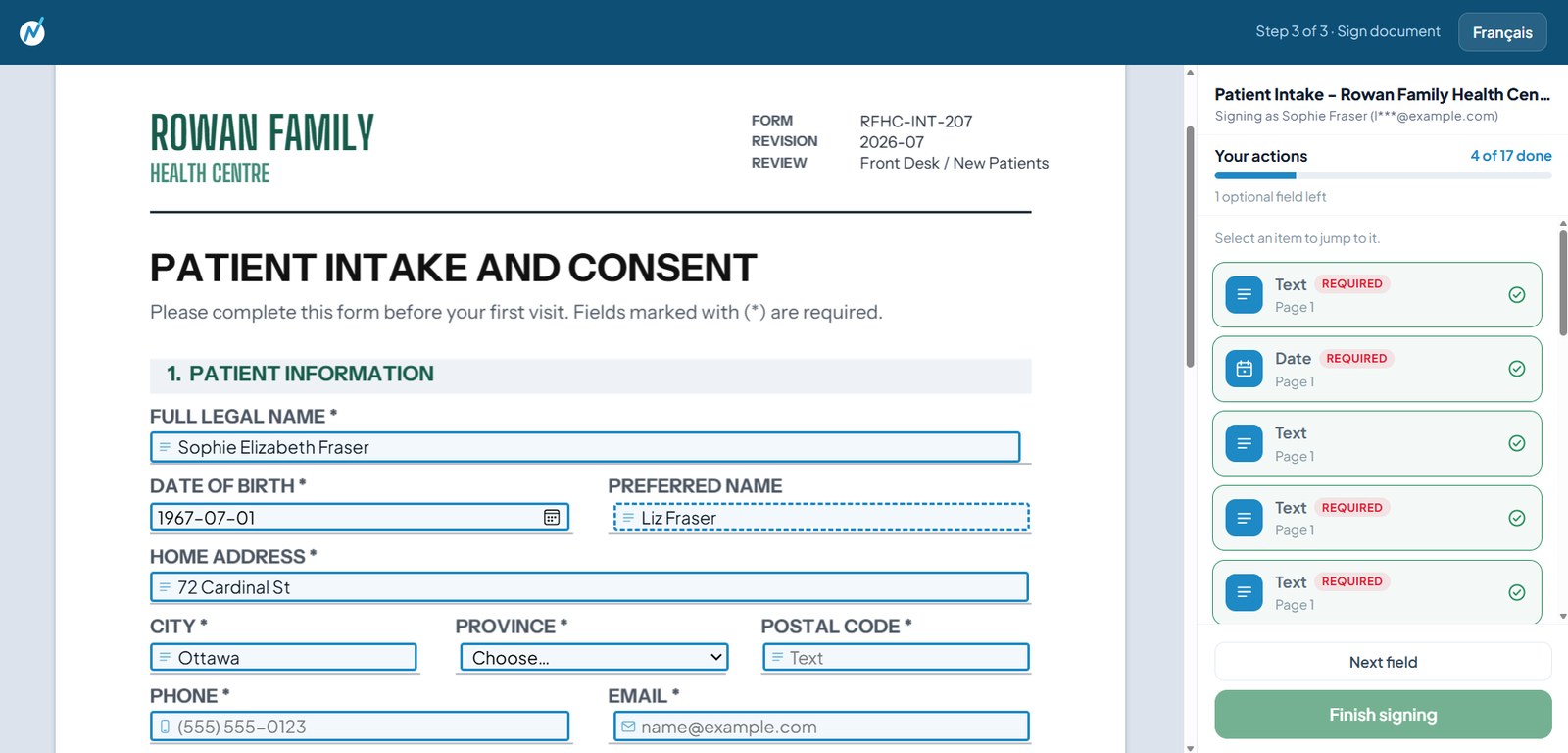
Introducing NimbleSign: A Fully Canadian E-Signature Platform, Built and Hosted in Canada
NimbleSign is here: a fully Canadian electronic signature platform, built and hosted in Canada by Nimble. It handles everyday remote signing from any device and turns tablets into in-person signing stations for places like clinic front desks. Every signature stays in Canada, under Canadian law, with a full record.
How the Kingston ODSP Office Recovered 7,500 Files After a Fire
After a December 2016 fire compromised roughly 12,000 client files at the Kingston ODSP office, Nimble cleaned the records and digitized and indexed 7,500 active files within a three-month window. About 4 million pages of client files are now securely accessible online through a Canadian-hosted portal.

How Birchwood Automotive Group Cut Document Retrieval From Days to Seconds Across Its Dealerships
Birchwood Automotive Group, Manitoba's largest automotive retailer, cut the time to retrieve a service work order from days to seconds. Nimble's Winnipeg team digitized the work orders and centralized them in SmartCloud, giving Central Services full oversight while keeping each dealership's records private, and tracking every document from creation to secure disposal.